
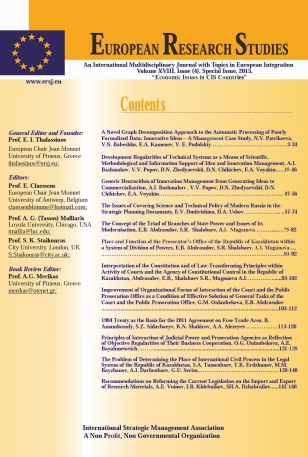

“European Research Studies Journal”
ISSN: 1108-2976
ICV 2022: 88.33
The result of the assessment in the ICI Journals Master List database – the Index Copernicus Value (ICV) – is a measure of the parametric power of a scientific journal. It indicates to what extent the journal meets international standards in the field of key functional areas of this medium of science.
The ICV consists of two main components: quality of the journal and journal’s impact.
Description
| Subject Area | Business, Management and Accounting Business, Management and Accounting (miscellaneous) |
| Category | Economics, Econometrics and Finance Economics, Econometrics and Finance (miscellaneous) |
| Publisher | International Strategic Management Association, EU |
| ISSN | 1108-2976 |
Identifying Fake Journals
6 April 2023
Statement from COPE Officers
COPE believes that authors and institutions should treat lists of predatory (or fake) journals with the same degree of scrutiny as they do with the journals themselves. Lists that are not transparent about criteria used should not be relied on. Moreover, such lists may perpetuate systemic bias and include journals with limited resources, but which are legitimate journals with the best intentions.
COPE supports the use of Think.Check.Submit. A simple checklist authors can use before submitting research to a journal. Think.Check.Submit. asks the author questions aligned with the Principles of Transparency and Best Practice in Scholarly Publishing, a set of criteria used by COPE, DOAJ, OASPA and WAME when assessing journals which apply for membership of their organizations. Many predatory journals and publishers do not fulfil these criteria.
COPE’s Predatory Publishing discussion document expands on how authors, reviewers, editors, and institutions can identify predatory journals.
Related resources:
Think.Check.Submit.
Predatory Publishing, COPE discussion document
Avoiding predatory publishers, guest article
Indexes